
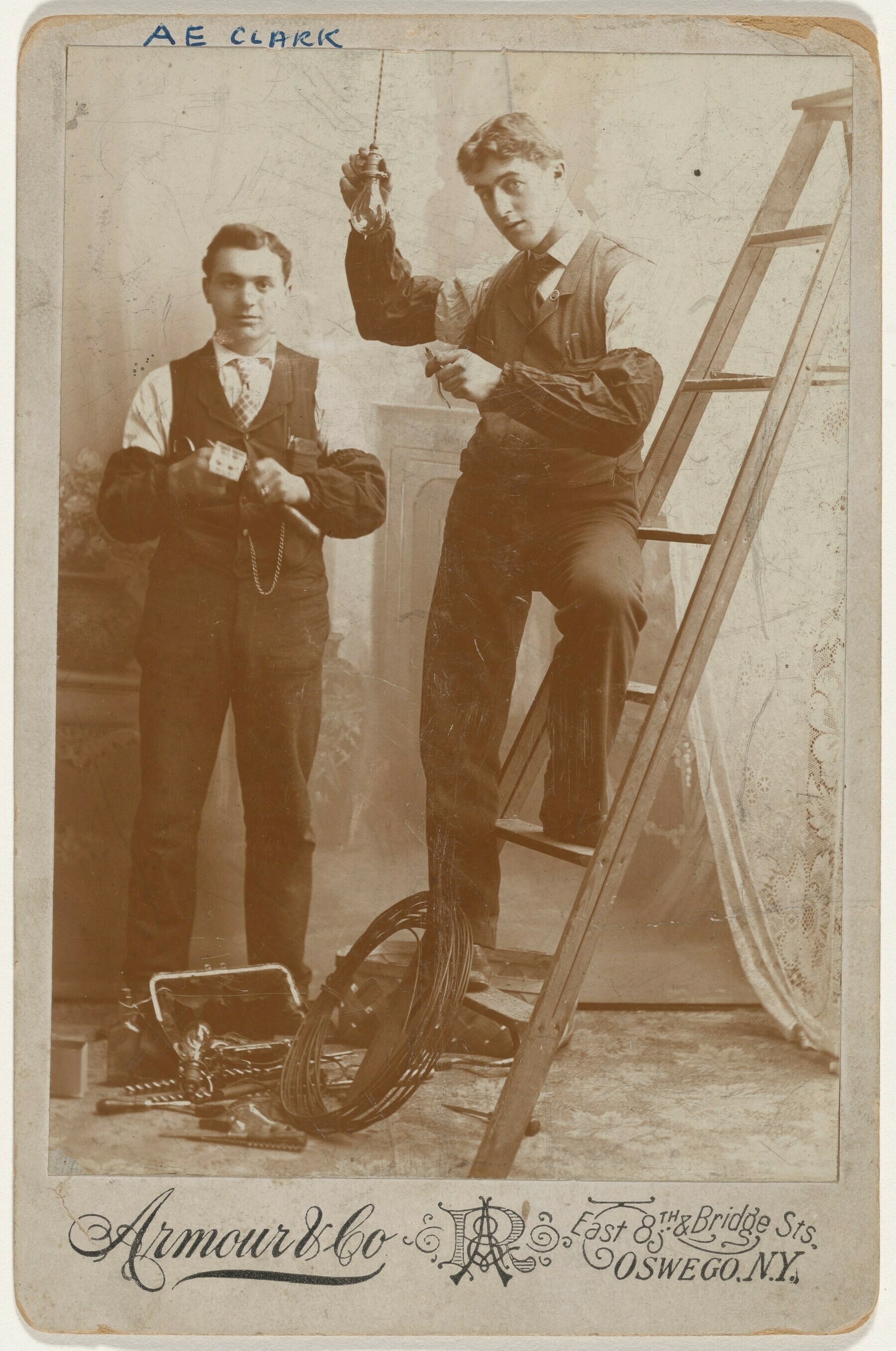
Public domain image of the day. Armour & Co. Portrait of Electric Light Installers, c. 1904. National Gallery of Art.
“Bad programmers worry about the code. Good programmers worry about data structures and their relationships.” - Linus Torvalds
"Illegibility comes from complexity without clarity."
This past summer, I gave a lecture at a web conference and afterward got into a fascinating conversation with a young digital design student. It was fun to compare where we were in our careers. I had fifteen years of experience designing for web clients, she had one year, and yet some how, we were in the same situation: we enjoyed the work, but were utterly confused and overwhelmed by the rapidly increasing complexity of it all. What the hell happened? (That’s a rhetorical question, of course.)
From Everything Easy is Hard Again, an important perspective on web design by Frank Chimera.
Spent some time in the Gapingvoid Culture Design Group archives. I liked these in particular.
Simplicity is Complexity Resolved - Gapingvoid
curation
Loved this curation by Tim Krieder of the current exhibition of artwork by Met Museum staff.
Must read: Tara McMullin on Seeing Software.
I especially liked the part about approaching choosing software as though you were interviewing someone for a job.
the trust thermocline
Came across this on Bluesky.
The trust thermocline is pretty interesting.
It’s the idea that for some products, irreversible consumer trust damage can happen far in advance of its impact.
Examples in the article include Disney Parks (people look forward to recreating childhood memories with their kids, but lately, lots of people don’t seem to be having positive experiences at Disney) and Evernote (which used to be the note-taking app, but lost trust through a variety of poor decisions. And of course there’s Twitter.
I appreciated this piece for putting a clear name and description (a well-chosen metaphor!) onto a phenomenon that I had observed but hadn’t been able to fully parse.
It’s good to know about the trust thermocline, but also great to have this example of someone observing a phenomenon over time and finding the right analogy and explanation to make it visible and intelligible.
Who sold us the idea that we need a tagline?
Appreciated Fred Tally-Foos' piece niching down is bad and inhuman about the idea that “we need to be able to give our elevator pitch, explain who we are in a concise way on a resume or an Instagram bio, and use that clarity to move forward in life.”
I imagine prior generations weren’t considering very often the idea that they might be seen by countless masses of people who would need to understand “who they are” quick enough for a sound bite. Quick enough for a viral share or a Love Island intro. What’s your Housewives tagline? What’s your deal? Who are you?
I’ve been thinking about this too, as I think about re-doing my website and going back to having a newsletter. I’ve been seeing the same line of thought from others online, including Charlie Gilkey who recently merged two different newsletters (one on personal productivity, one on team habits) because separating the two topics he was interested in had become confusing and a drain on his energy.
At a certain point, we have to trust that the combination of things that are interesting to us are interesting to others as well.
Who sold us this idea that we need a “tagline”?
It comes from forms of communication that we did not invent around our own interests.
(A related interesting read recently was Tara McMullin on the crisis influencer and particularly the concept of moral injury as it relates to this phenomenon.)
Tools updates 11.2024
Browser: Arc Browser for Windows was life-changing a few months ago, but it’s a bit slow on my computer so I’m trying out Zen Browser this week.
Read-it-later: Omnivore is shutting down, and I just haven’t been able to get into Readwise. I’m going to try Raindrop, which is more of a bookmarking tool but may work for my use cases.
Email: Still trying out Spark. Not bothering with the AI features but I like the “set aside” feature, the home screen, and the sorting. Not sure if I’ll stick with it but I like it for now.
Task management: Giving another fresh start to Sunsama. I loved Sunsama for a while, but things got too fragmented (too much backlog, inability to predictably plan my workdays) so I’m starting fresh again.
RSS reader: Haven’t been able to commit to one. Would like to.
On hope
Two recent perspectives, both nourishing: from Mariame Kaba and Perdita Finn.
I also appreciated Toi Smith’s most recent newsletter which included a summary of Alexis Pauline Gumbs' 100 days ritual.
This was a delightful little read.
No spoilers, but I too remember when I learned the phrase in question and what a revelation it was.
via Jorge Arango's newsletter
The hallmark of expertise is no longer how much you know. It’s how well you synthesize. Information scarcity rewarded knowledge acquisition. Information abundance requires pattern recognition. It’s not enough to collect facts. The future belongs to those who connect dots.
— Adam Grant (via X)
I had been thinking about why the proliferation of new apps for collecting and synthesizing information (see: Sublime, Tana, mymind, alongside Obsidian, Roam Research, etc) and this quote puts it quite succinctly.
learning about message design...
Because cognitive dissonance is the mental spark that turns contemplation into action, creating it is a requirement for instigating long-term change. – Tamsen Webster
ruthless
Be ruthless in learning what’s actually going to work for you.
Discern between the things that feel they’re not going to work because you’re afraid and the things that aren’t going to work because they’re just not right.
From longform.asmartbear.com/worse-but-unique
Playing on your own terms changes the game. “Worse, but unique,” is in fact “better.”
From Good Strategy, Bad Strategy by Richard Rumelt
At the core, strategy is about focus, and most complex organizations don’t focus their resources. Instead, they pursue multiple goals at once, not concentrating enough resources to achieve a breakthrough in any of them.
Lots more to say about this book later.
Say what you will about my obsession with process...
…but I wouldn’t have made any of these posts if it weren’t for the Obsidian Micro.blog plug-in that lets me post these directly from Obsidian.
It doesn’t SEEM like it would be that much work to open the browser and copy-paste a short post, but it’s just enough friction that I think I’d somehow “not have time.”
What else can become possible when we remove just a little friction?